Behavior-to-explainer structure
Start with one familiar behavior. The Psychology Facts Generator turns it into recognition, cue, mechanism, example, small action, and test instead of one unstructured paragraph.
Clear explanation
Psychology facts workbench
Free tool. No sign-in. 30-180-second script draft.
Timed voiceover draft
Your psychology behavior explainer
Your timed psychology reel will appear here
The Psychology Facts Generator separates recognition, cue, mechanism, example, small action, and test for review.
This output is a script draft, not a finished video. Review facts, sources, rights, privacy, and platform policy before publishing. It does not provide diagnosis or professional advice.
Continue the creator workflow
Explore related creator tools
Faceless Reels Idea Generator
Compare three short-form angles before choosing a behavior.
Faceless Reels Script Generator
Write a timed voiceover for a non-psychology topic or content lane.
Faceless YouTube Niche Finder
Check whether a psychology-reel channel can support repeatable output.
YouTube Shorts Niche Finder
Plan a narrow Shorts format for recurring psychology ideas.
Quick answer
The Psychology Facts Generator is a free, no-sign-in tool that turns one behavior or your research notes into an editable 30- to 180-second voiceover draft for psychology facts reels. It returns a title and six timed beats, not a finished video.
Choose Behavior explainer or research-notes mode, set duration and language, then review recognition, cue, mechanism, example, small action, and test. Verify every factual claim and source; the output is not a diagnosis or professional advice.
Output format
The Psychology Facts Generator returns one title and six timed narration beats. Its visible reasoning path makes an unsupported mechanism, vague example, or oversized promise easier to spot before you record a voiceover. The psychology facts generator is a drafting aid, not a source of proof.
| Explainer beat | Job in the script | Review question |
|---|---|---|
| Recognition | Make the behavior immediately relatable. | Can viewers recognize the moment without being labeled? |
| Cue | Identify what happens immediately before the behavior. | Is the trigger observable rather than assumed? |
| Mechanism | Explain one plausible mechanism in plain language. | Is the explanation accurate, bounded, and non-diagnostic? |
| Example | Show the pattern in one everyday situation. | Does the example clarify the idea without overgeneralizing? |
| Small action | Offer one bounded action a viewer can try. | Is the action practical and presented without a guarantee? |
| Test | Close with a one-week experiment and a clear caveat. | Can the viewer observe the result and seek help when needed? |
Static output example
This fixed 60-second Psychology Facts Generator example shows the six-part output format. It offers one possible explanation and a bounded test, not a diagnosis or a guaranteed result.
Step 01: Recognition
7sAn unfinished task can return to your mind even when a finished task disappears from attention.
Step 02: Cue
8sThe loop often starts when you see the message, document, or reminder connected to the task.
Step 03: Mechanism
12sOne explanation is that an open goal stays easier to retrieve because your brain is still tracking what needs to happen next.
Step 04: Example
12sThat is why a half-written reply may keep resurfacing while several completed replies barely cross your mind.
Step 05: Small action
11sTry writing one concrete next step before you pause, such as: answer the first question tomorrow at nine.
Step 06: Test
10sTest it for one week and notice whether the task returns less often. This is a planning experiment, not mental-health advice.
Editorial review updated by MakeFacelessReels on . Review scope: visible controls, six output labels, stated limits, copy action, and Script & Caption handoff. Generation quality varies by input and still requires editorial review.
Evidence notes
The Psychology Facts Generator static example uses one 2011 Journal of Personality and Social Psychology paper as a bounded source. It supports a possible goal-activation mechanism, not a universal rule or a mental-health diagnosis.
| Claim | Evidence | Scope | Caveat |
|---|---|---|---|
| Unfulfilled goals can remain cognitively active. | The paper reports six study labels: Studies 1, 2, 3, 4, 5A, and 5B. Its abstract describes intrusive thoughts, accessible goal-related words, and interference with unrelated tasks. | Experimental tasks involving activated but unfinished goals. | This supports one possible mechanism. It does not show that every unfinished task affects every person in the same way. |
| Specific planning reduced the effects observed in those studies. | The authors report that allowing participants to make specific plans eliminated the activation and interference effects measured in their tasks. | A 2011 journal article about plan making and unfulfilled goals. | The finding does not establish a treatment, diagnosis, or guaranteed outcome for everyday planning. |
| The one-week test on this page is an editorial adaptation. | MakeFacelessReels converts the planning finding into a bounded self-observation prompt for a 60-second script example. | Content drafting and self-observation only. | The prompt is not a validated intervention and should not replace professional mental-health support. |
Primary source: Masicampo and Baumeister, 2011, PubMed PMID 21688924 (DOI 10.1037/a0024192).
Core capabilities
The Psychology Facts Generator uses four practical controls to shape a short behavior explainer. Each control changes the topic, evidence, timing, language, or production handoff. The psychology facts generator stays focused on an editable script rather than an automatic diagnosis.
Start with one familiar behavior. The Psychology Facts Generator turns it into recognition, cue, mechanism, example, small action, and test instead of one unstructured paragraph.
Clear explanation
Behavior explainer starts from a topic. Research-notes mode preserves supplied facts and caveats while tightening the spoken sequence; neither mode removes the need to verify sources.
Evidence-aware drafting
Choose 30, 60, 90, or 180 seconds and one of eight output languages. The Psychology Facts Generator allocates time across six narration beats for an editable pacing target.
Timing control
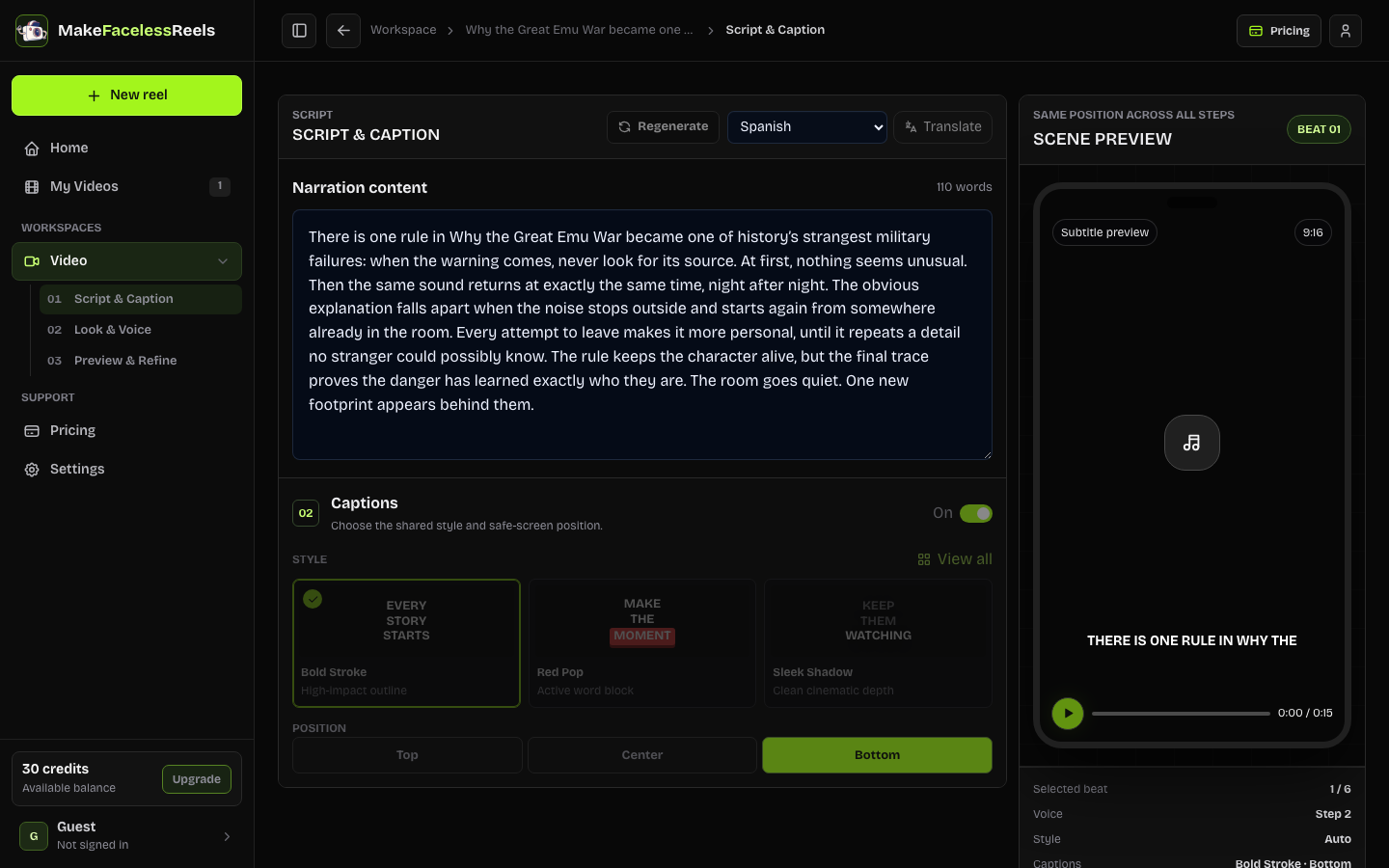
Copy the text or open the saved draft in Script & Caption. The psychology project can move into visual planning, voice, music, captions, and rendering without retyping the script.
Production handoff
Input and output specifications
The Psychology Facts Generator currently accepts the following input limits and output choices. These psychology facts generator settings are visible before generation so you can choose a realistic pacing target.
| Setting | Available options | What changes |
|---|---|---|
| Content basis | Behavior explainer or Based on my research notes | Starts from a topic or preserves supplied facts and caveats. |
| Topic or notes length | 20-5,000 characters | Sets the accepted input range before generation. |
| Target duration | 30, 60, 90, or 180 seconds | Allocates the pacing target across six explainer beats. |
| Script language | English, Spanish, Portuguese, Indonesian, Japanese, Hindi, Turkish, and Vietnamese | Returns the narration draft in the selected language. |
| Output | One title and six timed voiceover beats | Creates an editable script draft, not a finished video. |
How it works
The psychology facts generator works best when the input names an observable behavior, the cue that may precede it, and any source caveats. It does not need camera directions or a long prompt full of style adjectives. Treat the psychology facts generator as a first draft and verify the explanation against your sources.
Select Behavior explainer for a psychology topic, or Based on my research notes when facts and source context must be preserved.
Name the behavior, its observable cue, and any research notes you want the draft to use. Remove private or rights-sensitive details.
Choose a 30-second to 3-minute pacing target and one of the available script languages before generating the voiceover.
Check recognition, cue, mechanism, example, small action, and test. Verify factual claims and sources before copying or continuing.
Use cases
Each psychology facts generator idea below is narrow enough to research, explain, and test in one short video.
Build each episode around one observable loop, such as reopening unfinished messages or delaying a small task. Keep the six-beat format consistent while changing the behavior and evidence.
Start with one narrow psychology reel idea and choose 30 seconds. Keep one mechanism, one example, and one caveat; remove any claim that cannot be checked against a credible source.
Paste notes you have permission to use and choose Based on my research notes. The Psychology Facts Generator compresses them into timed narration while you remain responsible for meaning, accuracy, and usage rights.
Limits and quality control
The Psychology Facts Generator does not verify research, diagnose a condition, or provide professional advice. It also cannot confirm originality, copyright, consent, or privacy. Compare every claim with credible sources and qualified review where the topic is sensitive.
Timing and publishing
The Psychology Facts Generator assigns an editorial timing target, not a measured voice recording. Read the draft aloud at the intended delivery speed and split a layered explanation when it cannot fit without losing caveats.
Before publishing media drafted with the Psychology Facts Generator, check the exact disclosure rules for the platform and media type you are posting. Review YouTube's altered or synthetic content disclosure guidance and TikTok's AI-generated content guidance before release.
Frequently asked questions
A psychology facts generator turns a behavior or supplied research notes into a structured short-form script draft. This tool returns a title and six timed voiceover beats, but its claims and sources still need human review.
Yes. Choose a behavior or add research notes, select a 30- to 180-second target and one of eight languages, then generate six editable voiceover beats. Script generation and copying do not require sign-in, but every factual claim still needs human review.
Yes. Choose Based on my research notes and paste the facts, caveats, and source context the script should preserve. Compare the result with the original sources and confirm accuracy, ownership, consent, and privacy before publishing.
No. The Psychology Facts Generator is designed to explain behaviors and possible mechanisms without diagnosing a viewer or promising a treatment result. Its output is not medical, mental-health, or professional advice and requires qualified human review when the topic is sensitive.
No. The page creates an editable timed voiceover draft that can be adapted for TikTok, Instagram Reels, or YouTube Shorts; it does not create an MP4. Continue to Script & Caption to revise the text, then use the main workspace for visuals, voice, music, captions, and rendering.
Related next steps
Start from the faceless reels hub if you still need the format. Use the Faceless Reels Idea Generator when the topic is still broad. Choose the Faceless Reels Script Generator for a non-psychology topic, or open the full workspace after this psychology facts generator creates a draft you want to produce.
Start with one observable behavior
Use the psychology facts generator to shape a behavior or research notes into a timed explanation. Review the facts and caveats, copy the result, or continue into captions and visual production. The psychology facts generator keeps the final editorial decision with you.
Generate with the Psychology Facts Generator