Creator guide
Faceless YouTube Channel Ideas You Can Produce
Choose faceless YouTube channel ideas you can repeat for 12 videos, then check YouTube's 2026 monetization rules before you expect any payout.
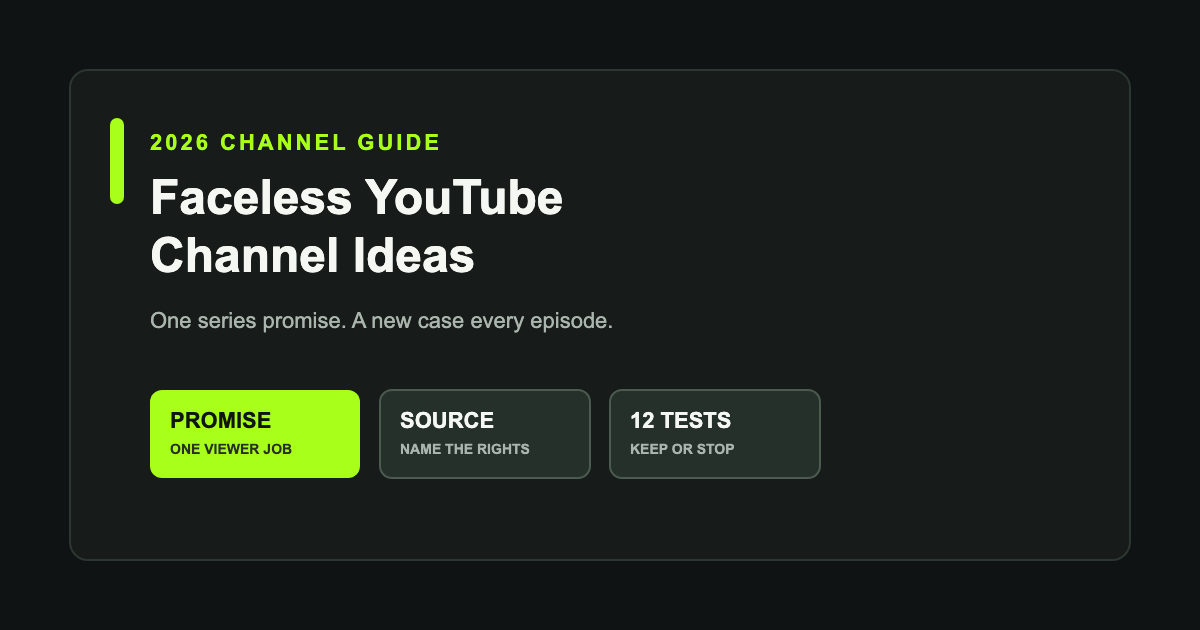
A useful faceless YouTube channel idea is a series promise you can source and vary for at least 12 uploads without putting your face on camera. "Finance," "history," or "facts" is only a topic. It does not tell you what episode 12 is about.
This page is for choosing a YouTube channel series. If the next file is a TikTok, Reel, or Short, use the separate guide to faceless reels niches. The subject can overlap. The length, hook, and packaging should not.
Key Takeaways
- Write a one-sentence series promise, then change the case in every episode.
- YouTube's monetization policies reject interchangeable templates, thin slideshows, and scraped videos, including generic AI templates.
- Partner Program figures come from two official posts: a February 3, 2025 explainer and an August 10, 2026 update that starts February 1, 2027 for new applicants.
- Twelve videos is this guide's planning cutoff, not a YouTube rule.
- Realistic synthetic faces, voices, places, or events need YouTube's disclosure label. Clearly unreal animation does not.
Unique insight: A crowded topic still has room when a stranger can tell episode 7 from episode 2. The limit is a sourced angle you can repeat, not a longer list of channel names.
Contents
- What makes a usable idea
- Filter it before you record
- Eight series to test
- Templates and reused footage
- Partner Program figures
- Qualified views
- Synthetic media labels
- Twelve-video pilot
- FAQ
What Makes a Faceless YouTube Channel Idea Usable?
A faceless channel hides the host. It does not hide authorship. You still need a point of view, a source you can name, and visuals you have the right to publish.
Write this sentence before you name the channel:
For [one kind of viewer], each video takes [one new case] and leaves them able to [one decision or clearer understanding].
"Scary stories" fails that test. "One public case file a week for night-shift listeners, with what the record proves and what it does not" passes it. The second sentence tells you how to research episode 12 after the first idea is used up.
Narration, captions, screen recordings, your own footage, licensed clips, diagrams, and animation are formats. None of them is the niche. The niche is the viewer plus the repeated job.
Filter the Idea Before You Record
Keep an idea only when you can say yes to all four checks.
- You can make the next episode. You already know the sources, the software, or the place. A topic you must research from zero every time will stall.
- The picture can change. A new document, screen, object, map, or diagram carries the episode. A reused stock loop does not.
- The substance can change. The same intro is fine. The same story with the nouns swapped is not.
- You can name the rights. Your footage, a license, a public-domain item, or a short clip you are actually commenting on. "Found on YouTube" is not a rights plan.
When those four answers are yes, make one short test before you outline a year of uploads. Build that first test on the homepage. Start from the idea or paste the script, then review the narration, captions, voice, and scene plan. The test shows whether the promise is clear in a vertical cut. It does not create the channel, clear copyright, or qualify the channel for monetization.
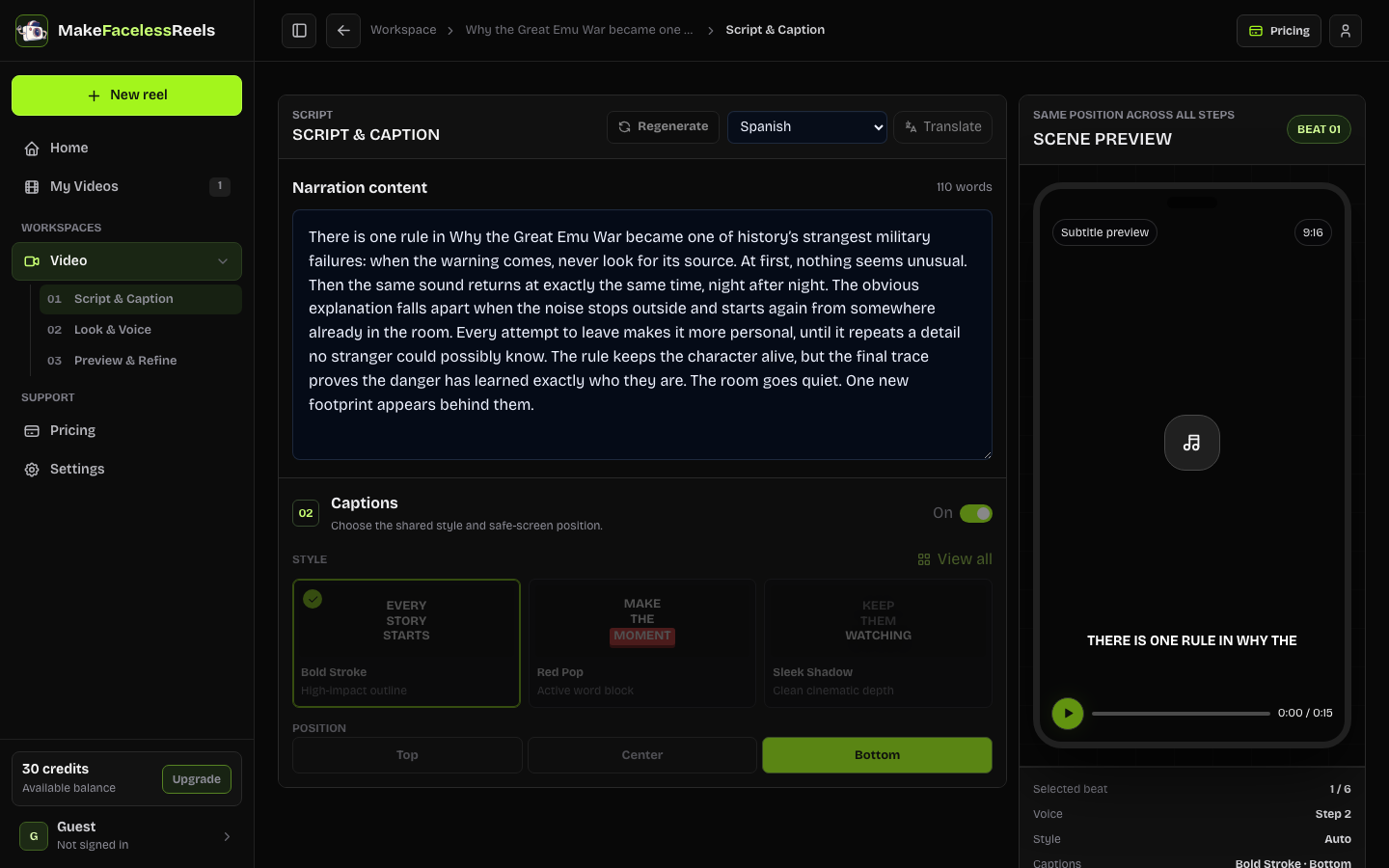
Read the first sentence out loud. If a stranger cannot tell what the episode will decide, fix that sentence before you generate the rest.
Eight Faceless YouTube Channel Ideas for a 12-Video Test
These are series frames, not a forecast of views or revenue. Each one keeps a narrow job and requires a new case every episode.
| Series | Promise | What must change | Rights watch-out |
|---|---|---|---|
| Public-meeting notes | One local decision, and who it affects | A different agenda item, vote, or document | Quote the public record. Do not read a private memo you do not hold. |
| One-document history | What a dated source proves, and what it does not | A different document, date, and limit | Use public-domain or licensed images. A movie clip is not a substitute. |
| Everyday mechanisms | How one real process works, then one action | A different bill, setting, refund, or form | Cite the institution. Do not invent a dollar outcome. |
| Job-task recordings | One task you personally performed on screen | A different task, file, and result | Record your own desktop. Blur accounts and client data. |
| Cited arguments | One chapter's claim turned into a choice | A different claim, example, and objection | Name the book. Do not upload a full reading of it. |
| Mistake clinic | One error in a craft you know, and the fix | A different mistake and example from your work | Use your own before-and-after. Do not restage someone else's footage. |
| Comparison lab | Two options scored on criteria you publish first | A different pair, with the same criteria | Disclose affiliate links. Do not copy a reviewer's script. |
| Object-led field notes | A process shown through the object, not a face | A different step, tool, or result | Film your own hands and objects, or use a license you can name. |
Public-meeting notes
Follow one council, board, or agency. Each video explains a single decision: what was proposed, what passed, and what a resident can do next. The series dies if you summarize "the news" instead of one document.
One-document history
Pick a letter, map, patent, or photo with a date. Say who made it, what claim people use it for, and which part of that claim the source cannot support. Episode value is the limit you found, not a dramatic retelling.
Everyday mechanisms
Explain one process a viewer can check, for example a security deposit, a subscription cancellation, a browser permission, or a paystub line. Show the official page or form you used. Skip any episode where you would have to guess the result.
Job-task recordings
Record a task you actually did. A spreadsheet cleanup, a file export, or a setup sequence is enough. The series stays original because the screen is yours. It stops being original when the recording is a compressed copy of another creator's tutorial.
Cited arguments
Take one claim from a book or paper and turn it into a decision the viewer can make this week. Credit the author in the video and the description. A full chapter read, even with a new AI voice, is a different and riskier project.
Mistake clinic
Teach one error you have made or repaired. Keep the examples yours: a photo, a project file, or a written walkthrough. Swapping the label on a viral clip does not create a new episode.
Comparison lab
Publish the criteria before you score the options. Price, setup time, and a task you ran are stronger than "which one is best." Change the pair each episode, not the adjectives.
Object-led field notes
Point the camera at the work. Processes such as repair, cooking science, plant care, and workshop tasks fit when the object changes and your narration explains the step. Stock footage of hands that are not yours puts you back into a rights problem.
A Repeated Format Is Fine. A Repeated Video Is Not.
YouTube's channel monetization policies include a July 15, 2025 note that renames "repetitious content" to "inauthentic content." The note says this content was already ineligible, and that the reused-content policy did not change. This draft checked the wording on the October 17, 2026 capture of that Help page.
The page says monetized content should be your original creation. If you borrow content, you need to change it significantly. It also says content should not be mass-produced, generic, or made only to collect views. Reviewers can judge the channel, not only one upload.
YouTube says a channel may follow a pattern. The same intro and outro can monetize when the bulk of each video is different. A character series or a review channel can monetize when each episode has a distinct story, focus, or concept. The substance has to be materially varied.
The same page lists examples that are not allowed to monetize:
- Similar videos with little commentary, narrative, or variation
- Characters put in the same situation, with the same outcome, on a storyline template
- Image slideshows, templated storylines, or scrolling text with little or no narrative
- AI-generated content from generic templates that does not add your own insight
Reused content, in that policy, means taking a video that is already on YouTube or another site and republishing it without significant original commentary, substantive changes, or real educational or entertainment value. Reviewers may look at your videos, channel description, titles, and video descriptions to see whether you made the content. If they cannot tell, monetization may be removed from the whole channel.
Commentary can be allowed. YouTube's examples include a critical review, a scene with rewritten dialogue and a new voiceover, a sports replay you explain, a reaction with commentary, and an edit that adds a storyline. Copyright rules still apply even when the reused-content example is allowed. A faceless voice does not make a scraped clip yours.
Read the Partner Program Posts Before You Expect a Payout
None of the official pages below publishes a CPM for faceless channels. Do not pick a series because a tool site says one topic "pays more."
YouTube has published two descriptions that are both still useful, and they do not match word for word.
On February 3, 2025, the YouTube Blog post YouTube Partner Program, Explained said creators need 500 subscribers, 3,000 long-form watch hours, or 3 million Shorts views to access fan-funding features and to promote their own products. The next sentence says that at 1,000 subscribers, 4,000 watch hours, and 10 million Shorts views, creators become eligible for ads revenue sharing and other benefits. That sentence uses "and." It does not describe an either/or path.
On August 10, 2026, New opportunities to earn and changes to the YouTube Partner Program said new applicants will need 8,000 qualified watch hours in the last 365 days, or 20 million qualified Shorts views in the last 90 days, for ads and Premium revenue sharing. The change takes effect February 1, 2027. YouTube says creators already in the program are not affected, and that fan-funding and shopping entry thresholds stay unchanged. The post does not restate a subscriber number. It does say the program included over 3 million creators. That is the size of the program, not a target for your niche.
The same August 10 post sets a separate Shorts rule. Beginning February 1, 2027, ads and subscription revenue sharing on Shorts requires 10 million qualified Shorts views in the last 90 days. A channel under that line can remain in the program and keep earning on long-form video. Shorts revenue sharing resumes after the channel crosses the line again.
The February 2025 explainer also gave a long-form watch-hour figure of 4,000. The August 2026 announcement raises the figure it states for new applicants to 8,000 qualified watch hours in 365 days. Treat them as two published statements. The later post defines "qualified" and the time window. The earlier sentence does not.
The official video below is the February 3, 2025 program overview. Use it to see how YouTube explained the program at that time. Use the August 10, 2026 post for the numbers that take effect February 1, 2027.
Qualified Views Are Narrower Than the Number on Screen
On August 12, 2026, YouTube Creator Liaison Rene Ritchie explained the counters in What are qualified watch hours and views?.
Qualified watch hours have to come from public long-form videos, including podcasts, or from archived livestreams. They do not include private videos, unlisted videos, deleted videos, a viewing that happened as an ad, Shorts watch hours, or livestreams that are not archived.
Qualified Shorts views have to come from public Shorts and be engaged views. An engaged view means the viewer stayed past the initial seconds. Loops do not count. Private Shorts, unlisted Shorts, deleted Shorts, ad views, long-form views, and image posts in the Shorts feed do not count. Engaged views can be checked per video in YouTube Analytics.
A series plan that depends on unlisted drafts, paid ad views, or looped Shorts will not fill the public qualified counter described in that post.
Label Realistic Synthetic Media
On March 18, 2024, YouTube added a Creator Studio control for realistic altered or synthetic media, including generative AI. Use it when a viewer could easily mistake the image or voice for a real person, place, scene, or event. The announcement is How we're helping creators disclose altered or synthetic content.
The post's examples include replacing one person's face with another's, generating a person's voice to narrate a video, making a real building appear to catch fire, and showing a fictional disaster moving toward a real town.
YouTube said a disclosure is not required when generative AI is used to draft a script, suggest an idea, or create automatic captions. Clearly unrealistic animation is also outside that requirement. For health, news, elections, or finance, YouTube said the label appears on the video, not only in the expanded description.
A clearly animated explainer can stay unlabeled under that post. A realistic scene of a real place, or a synthetic voice of a real person, should be labeled. The label does not replace a copyright or reused-content review.
Run a 12-Video Pilot, Then Decide
Publish 12 public episodes with the same promise and a different case each time. Twelve is the cutoff in this guide. YouTube does not require it, and you should stop sooner if the next episode has no source you can name.
Before episode 1, write the viewer, the promise, the source list, and the visual rule. Then make the first short test on the homepage so you can hear the hook and see whether each scene matches its line. Upload your own file to YouTube. Titles and descriptions should show what you researched, not only the topic keyword.
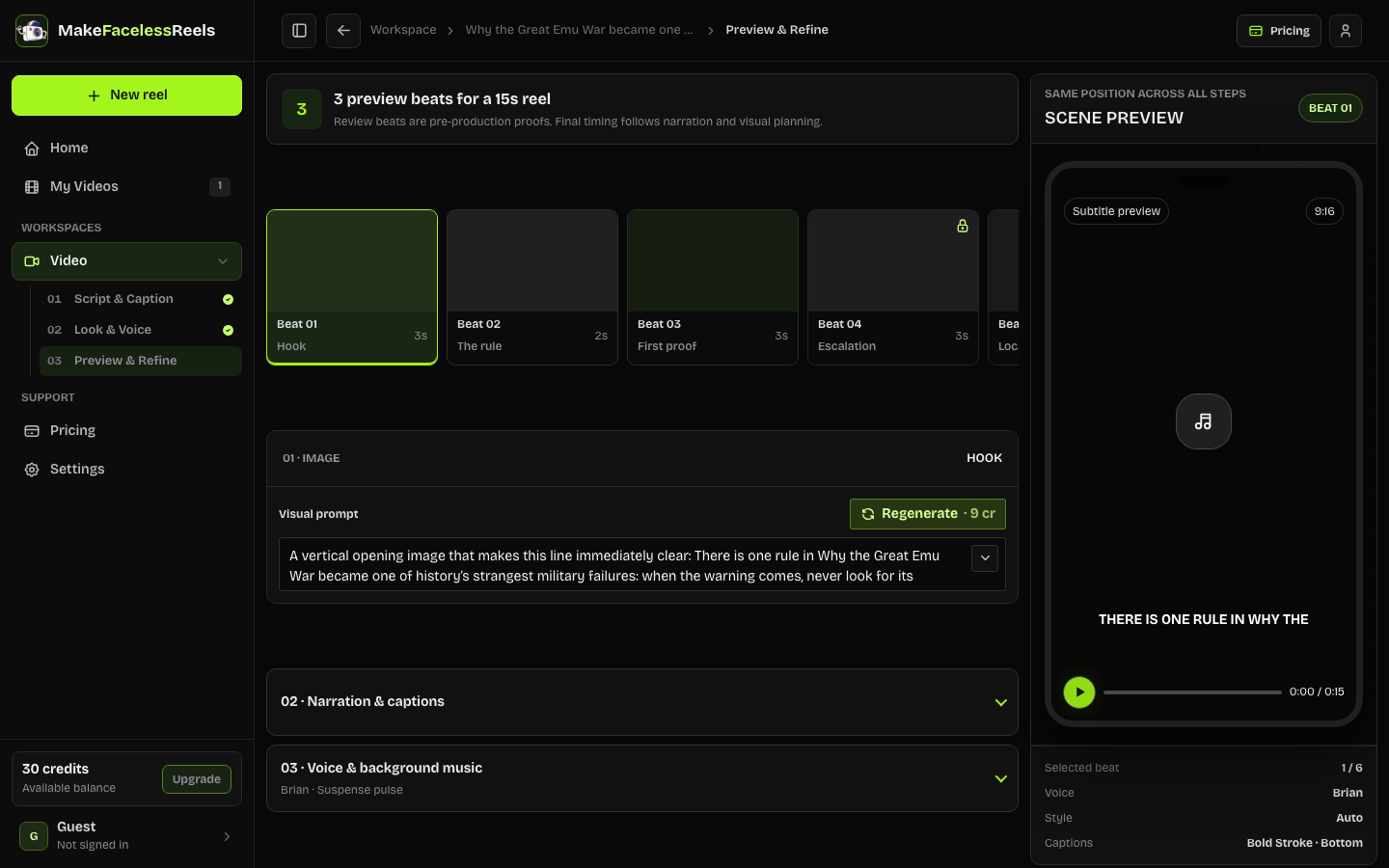
After 12 public videos, use your own YouTube Analytics:
- Can a stranger predict the job of the channel from the title alone?
- Can you name the source for episode 13 without taking another creator's video?
- Does retention move when the case changes, or is every upload flat in the same place?
Keep the series when the next case is still easy to vary. Narrow it when only one subtopic holds attention. Stop when every new episode needs someone else's footage or a template swap.
Questions about this guide or the product can go through About and Contact. More creator guides are on the blog.
Frequently Asked Questions
Do faceless YouTube channels qualify for the Partner Program?
Faceless format is not a separate eligibility rule in the YouTube posts cited here. Monetization policies still require original, authentic content, and the Partner Program uses subscriber, watch-hour, and Shorts-view thresholds that YouTube has published in more than one post. Check the August 10, 2026 update and YouTube Studio before you apply.
Can slideshow or AI-template channels be monetized?
YouTube's channel monetization policies say a repeated format can monetize when each video's substance is different. They list slideshows, templated storylines, scrolling text with little narrative, and generic AI templates without the creator's own insight as examples that are not allowed to monetize.
Are these the same as faceless Shorts niches?
No. A channel idea is a series promise you can sustain across many uploads. A Shorts, Reel, or TikTok niche is a short-form package. The subject can overlap, but the length, hook, and viewer job should be chosen separately.
How many videos should I post before judging an idea?
This guide uses a 12-video pilot: one promise and twelve episodes with different substance. YouTube does not publish that number. Stop earlier if you cannot name a legal source for the next episode.
Do I have to label AI visuals on YouTube?
YouTube's March 18, 2024 disclosure post requires a label when realistic altered or synthetic media could be mistaken for a real person, place, scene, or event. Clearly unrealistic animation, script drafts, idea generation, and automatic captions do not need that label under the post.
Sources
- YouTube channel monetization policies, YouTube Help. July 15, 2025 inauthentic-content note reviewed on the October 17, 2026 capture.
- YouTube Partner Program, Explained, YouTube Blog, February 3, 2025.
- New opportunities to earn and changes to the YouTube Partner Program, YouTube Blog, August 10, 2026.
- What are qualified watch hours and views?, YouTube Blog, August 12, 2026.
- How we're helping creators disclose altered or synthetic content, YouTube Blog, March 18, 2024.