Creator guide
How to Create Faceless Reels That Attract Buyers
Build faceless Reels around a specific buyer problem, useful proof, and one clear next step. Use this practical framework to turn attention into qualified clicks without promising viral reach.
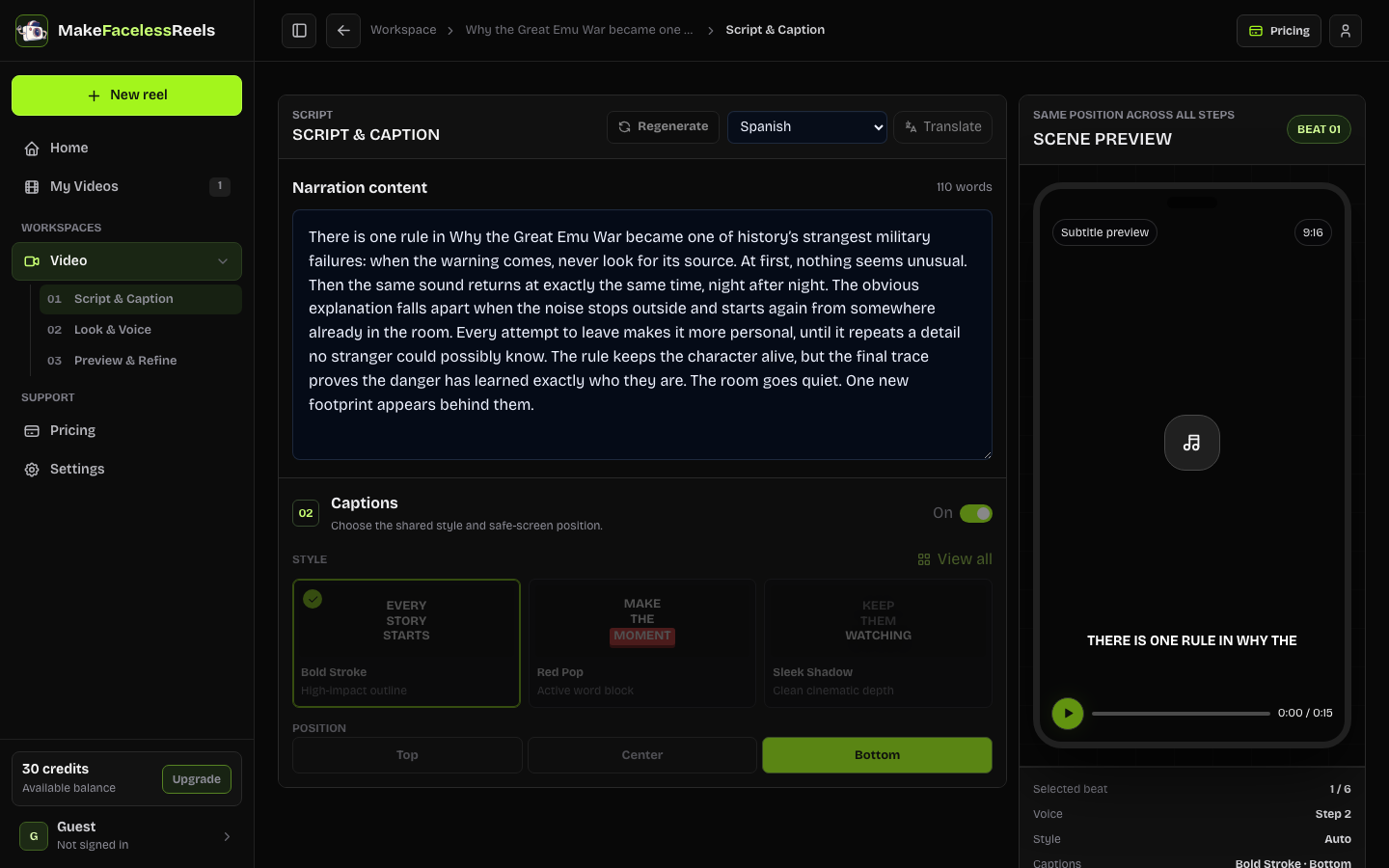
A faceless Reel can attract buyers without showing the creator’s face, but “viral” reach is not a sales plan. The useful goal is to reach people with a real problem, help them make progress in the video, and offer one relevant next step. A smaller audience with a clear need can be more valuable than a large audience that has no reason to act.
This guide turns that idea into a repeatable workflow: define the buyer, choose a problem worth addressing, write a useful short script, connect it to an honest offer, and measure what viewers do after watching. It applies to Instagram Reels and other short-form platforms, with platform rules checked separately before publishing.
Key Takeaways
- Start with one buyer and one problem, not a broad niche or a viral trend.
- Give the viewer a complete, useful takeaway before presenting an offer.
- Use a single call to action that matches the viewer’s readiness.
- Treat testimonials, affiliate links, and product claims carefully; disclose relationships and substantiate claims.
- Track qualified actions such as product-page visits, sign-ups, and purchases alongside views and watch time.
Views and buyer intent are different signals
A high view count tells you that a video was distributed and watched. By itself, it does not show whether the audience fits your offer, trusts your recommendation, or took a commercially meaningful action. A buyer-focused Reel makes its intended audience and problem recognizable early, then earns the next step by delivering useful information.
That does not mean every post should be a pitch. A practical content system can include discovery posts that name a problem, teaching posts that demonstrate a solution, proof posts that show how a process works, and offer posts that explain what the product helps someone do. The mix should follow your audience’s questions and your own results; a fixed “three value posts for every sales post” ratio is a rule of thumb, not a platform requirement.
Define the buyer before writing the hook
“People who want to grow on Instagram” is too broad to guide a useful script. Narrow the audience until you can name a situation, a goal, and a reason the person has not reached it yet.
Use this brief:
| Prompt | Example |
|---|---|
| Who is this for? | A solo bakery owner who posts irregularly |
| What are they trying to do? | Show new weekly products and get local pre-orders |
| What gets in the way? | Filming and editing takes longer than preparing the menu |
| What can this Reel help them do? | Record a repeatable 15-second product walkthrough |
| What is the next step? | Download a shot list or view a relevant service |
The example identifies a real workflow problem rather than assuming the viewer wants a generic “social media growth” promise. If you are still choosing a topic area, use the faceless Reels niche guide to compare ideas by repeatability, sourcing, and visual fit.
Build the Reel around a clear buyer problem
A simple structure is specific situation → useful answer → evidence or demonstration → next step. It is a planning tool, not a guarantee of virality.
- Open with the situation. Name who the advice is for or the problem they recognize. Avoid inflated promises such as “This trick guarantees sales.”
- Deliver one useful answer. Explain a step, comparison, mistake, or decision rule the viewer can use without buying anything.
- Show how it works. Use a screen recording, original diagram, product demonstration, licensed footage, or a brief example. Make the visuals support the narration instead of decorating it.
- Connect the offer. Say what the resource or product helps with and who it suits. If the offer does not solve the problem in the Reel, leave it out.
- Choose one next action. Ask the viewer to visit a page, download a resource, compare options, or send a message. One clear action is easier to understand than a string of competing requests.
For instance, a Reel for a bookkeeping service might start with “If you reconcile your shop sales at month-end, separate refunds before comparing payout totals.” It can demonstrate the calculation, then invite viewers who want help with the whole process to review the service page. The advice stands on its own; the CTA offers a deeper path.
If you are making the video with narration and scene-based visuals, the faceless Reel script generator can help shape an idea into a draft. Review the hook, every claim, and each scene before using generated material. A tool can speed up production, but it cannot verify that an offer is right for a particular buyer.
Choose formats that answer purchase questions
Use formats that help viewers assess a problem, a process, or a product. Make the examples specific to your actual experience and evidence.
| Format | Buyer question it answers | Example angle |
|---|---|---|
| Decision guide | “Which option fits my situation?” | Compare two scheduling workflows for a one-person business |
| Mistake and correction | “What should I stop doing?” | Show why a product photo loses context when the price or size is missing |
| Demonstration | “How does this work?” | Record the steps to prepare a weekly menu post |
| Objection answer | “Will this work with my constraints?” | Explain what a beginner can do with a phone and window light |
| Proof breakdown | “Why should I trust this?” | Walk through a real, permission-cleared example and explain what changed |
| Product comparison | “What am I paying for?” | Show which tasks a service covers and which remain the customer’s responsibility |
Do not invent customer results or present an unusual result as typical. If you use an endorsement, affiliate relationship, gifted product, or sponsorship, make the connection clear. The FTC’s social media influencer disclosure guidance recommends placing disclosures where viewers will notice them; for a video endorsement, use an in-video disclosure as well as any relevant caption disclosure.
Write a CTA that fits the video
A useful CTA has one action and a clear reason to take it. Match the ask to the value delivered:
- Low commitment: “Save this checklist for your next product shoot.”
- Resource: “Get the printable shot list from the link in my profile.”
- Consideration: “See the full feature comparison on the product page.”
- Purchase: “View the plan details and check whether it includes the workflow you need.”
Avoid false urgency, vague “DM me to learn more” instructions, and promises the landing page cannot support. If you ask people to comment for a resource, state exactly what they will receive and provide it as promised. Automation may simplify delivery, but engagement bait and unsolicited messages can damage trust and may conflict with platform rules. Check the current rules for the account and automation provider before relying on that flow.
For affiliate or sponsored recommendations, explain the relationship near the recommendation. The FTC notes that a platform disclosure feature may not be enough on its own, and the endorsement itself should not claim experience you do not have.
Make faceless visuals feel credible
A faceless format still needs a recognizable source of trust. That can come from a consistent visual system, clear narration, readable captions, accurate demonstrations, and details that show the creator understands the subject.
- Keep the first frame and opening line about the viewer’s situation.
- Use captions that match the spoken words and remain easy to read on a phone.
- Prefer original screen recordings, diagrams, product footage, or media with documented reuse rights.
- Keep claims on screen long enough to understand, and add a source when the Reel makes a factual claim viewers may want to check.
- Use a consistent look, but vary scenes when the subject changes. Repeating the same stock clip does not make the content more persuasive.
- Check the exported video with sound on and off before uploading.
TikTok’s Creator Rewards guidance is one example of why originality matters beyond aesthetics: its program rules require qualifying videos to be original, high-quality, and at least one minute long, alongside account and video eligibility conditions. Those rules concern a specific TikTok rewards program; they do not define a universal ideal Reel length or promise monetization. Review the current rules for every platform and program you plan to use.
Measure the path from view to purchase
Use platform analytics to diagnose the video, then use link or store analytics to understand the business outcome. Keep the stages separate so a weak click-through is not mistaken for a weak hook, or strong reach for strong sales.
| Stage | Useful signals | What to investigate when it is weak |
|---|---|---|
| Attention | Plays, initial retention, average watch time | Does the opening identify a relevant problem quickly? |
| Understanding | Saves, shares, substantive comments | Is the advice specific and easy to apply? |
| Consideration | Profile visits, resource requests, product-page sessions | Does the CTA explain the next step and its value? |
| Conversion | Qualified leads, purchases, refunds | Does the offer and landing page match the Reel’s promise? |
Compare similar posts on the same platform and over a consistent time window. Do not treat raw view counts from different platforms as equivalent, and avoid changing the hook, offer, landing page, and audience all at once. Make one change, publish another small batch, and record the result. The Instagram transcript generator can also help turn a public Reel or supplied captions into text for reviewing hooks and structure; use the text as research input, not as permission to copy another creator’s work.
A practical first-week test
A small, structured test is more informative than trying to manufacture a viral hit.
- Choose one audience and one offer.
- Write three buyer problems that the offer genuinely helps address.
- Make one Reel per problem using a different useful format, such as a demonstration, decision guide, or objection answer.
- Give each video one matching CTA and use tracked links where appropriate.
- Review retention, saves, profile visits, qualified clicks, and conversions after a consistent period.
- Keep the clearest audience-problem match, then make another set of variations around it.
This is a working experiment, not a benchmark. Your posting cadence, audience size, offer price, and sales cycle affect how much evidence a week can provide. If you need a production walkthrough first, see how to make faceless TikTok videos, then adapt the file and packaging for the destination platform.
Frequently asked questions
Can faceless Reels really attract buyers?
Yes. A creator does not have to appear on camera to explain a problem, demonstrate a process, or recommend an offer. Buyers still need a clear point of view, useful evidence, an honest disclosure when relevant, and a next step that matches the video. No format guarantees reach or sales.
Should every Reel include a sales CTA?
No. Use a direct offer when the video answers a buyer question and the offer is a sensible next step. Other videos can earn attention, explain the problem, or demonstrate proof without asking for a purchase. Measure the mix by qualified actions and audience response, not a fixed posting ratio.
Are comment-to-DM automations a reliable way to get sales?
They can make a requested resource easier to deliver, but they do not guarantee conversion or reach. Make the promised resource clear, use platform-compliant tools, avoid unsolicited follow-up, and keep a direct link or alternative route available.
Do affiliate links need to be disclosed in a Reel?
In the United States, the FTC says a financial or other material connection should be disclosed clearly and conspicuously. Put the disclosure with the endorsement, and for video include it in the video itself rather than relying only on the caption or profile.
Sources
- Disclosures 101 for Social Media Influencers, Federal Trade Commission
- The FTC’s Endorsement Guides: What People Are Asking, Federal Trade Commission
- Creator Rewards Program, TikTok Support